• Hello guest! Are you an Apistogramma enthusiast? If so we invite you to join our community and see what it has to offer. Our site is specifically designed for you and it's a great place for Apisto enthusiasts to meet online. Once you join you'll be able to post messages, upload pictures of your fish and tanks and have a great time with other Apisto enthusiasts. Sign up today!

Wild caught A. Ortegai shyness and hiding

MacZ

Well-Known Member
5 Year Member
Messages
4,323
Location
Germany
but when you have carbonate buffering some of that buffering is in solution as bicarbonate (HCO3-) or carbonate (CO3--), meaning that you have more Total (or Dissolved) Inorganic Carbon T(D)IC.
This is what I was missing. Thank you!
 

anewbie

Well-Known Member
5 Year Member
Messages
2,702
So if i understand correctly - in the end it doesn't have more co2 per sey but it has more carbon which is the important piece of information as that is what allows the plants to grow better.
 

dw1305

Well-Known Member
5 Year Member
Messages
2,979
Location
Wiltshire UK
Hi all,
So if i understand correctly - in the end it doesn't have more co2 per sey but it has more carbon which is the important piece of information as that is what allows the plants to grow better.
It depends, not all plants can use bicarbonate (HCO3-) as their DIC source. Plants that naturally occur in acidic water may not have the enzymes required.

Cheers Darrel
 

TacocaT

New Member
Messages
25
Location
Canada
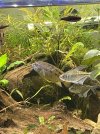
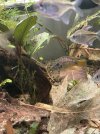
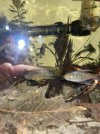
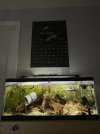
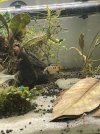
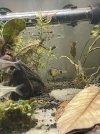
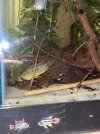
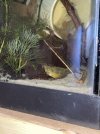
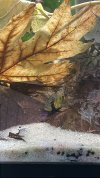
Thank you MacZ for your insight, it most likely was the bright setup. Ever since I added more twigs and various leaf litter from outside, the pair has been much more active and unafraid of me.

IMG_3402.jpeg


IMG_3409.jpegIMG_3410.jpegIMG_3389.jpeg

I did notice that the male has recently been exhibiting some weird thrashing behaviour, almost like he’s trying to scratch an itch. Every now and then he’ll stop in his tracks and thrash about, almost crashing into hardscape and plants before going back to idling. Any ideas?
 

Attachments

  • IMG_3404.jpeg
    IMG_3404.jpeg
    2.2 MB · Views: 96

TacocaT

New Member
Messages
25
Location
Canada
Perhaps it’s related to the black spots? They’ve begun to appear on both the male and the female, and after some research I assuming it’s one of those relatively harmless multi-species parasites that travel onto bird. Is it possible that they may cause itching and general discomfort on the fish? I don’t think it’s because of an injury or infectuon as otherwise the fish looks great.
 

MacZ

Well-Known Member
5 Year Member
Messages
4,323
Location
Germany
I did notice that the male has recently been exhibiting some weird thrashing behaviour, almost like he’s trying to scratch an itch. Every now and then he’ll stop in his tracks and thrash about, almost crashing into hardscape and plants before going back to idling. Any ideas?
I have seen this a lot when my dwarfs foraged through the tank, getting detritus particles on their bodies.

Perhaps it’s related to the black spots? They’ve begun to appear on both the male and the female, and after some research I assuming it’s one of those relatively harmless multi-species parasites that travel onto bird. Is it possible that they may cause itching and general discomfort on the fish? I don’t think it’s because of an injury or infectuon as otherwise the fish looks great.
I don't see any irregular black spots i the pictures. Care to elaborate?
 

TacocaT

New Member
Messages
25
Location
Canada
I have seen this a lot when my dwarfs foraged through the tank, getting detritus particles on their bodies.


I don't see any irregular black spots i the pictures. Care to elaborate?
The spots show up much clearer on the female. In older images you can see that the forehead is simply darker and is otherwise clear of markings.
IMG_3132.jpegIMG_3131.jpeg

However recently you can see some black spots on the forhead. The male has some too, but they blend in better with the existing patterns.
IMG_3391.jpegIMG_3392.jpegIMG_3318.jpeg
 

Mike Wise

Moderator
Staff member
5 Year Member
Messages
11,869
Location
Denver, Colorado, U.S.A.
Are these wild caught fish? If so my guess is that they are black spots caused by a diagenetic parasite and won't spread on the fish or to other fish. Here are some photos of my fish:

1765209294448.png


The ones on the left are wild fish I brought back from Peru. The ones on the right are some of their offspring spawned and raised in my tanks. None of the offspring ever show black spots.
 

Apistonaut

Member
Messages
73
Location
Minnesota, US
Trust me. I have been trying my best while avoiding using chemicals. I added ramshorn snails last week and I’ve been removing as much as I can every other day to no avail.

Next time I clean the filter I’ll add some dried Cyanobacteria there, as I heard that does something. Why? No idea but it’s worth a shot.
I've used the Ultralife blue green slime remover stuff with over 50-60+ 1 week old fry, multiple times. I had no related losses. In other tanks, I haven't experienced a single loss to fish or shrimp with the product either. It is suspected to be an enzymatic villain to cyanobacteria. My cyano disappears in 48 hours and I follow up with a 50% WC. It always returns, but can take weeks/months if you are diligent about keeping water lean and aggressive with cleaning organics.

There are no snails, fish, or shrimp that will eat cyanobacteria. It's an indigestible film of bacteria, not algae.

I've yet to find a reliable cure for cyano in organic rich tanks other than blue green remove/chemiclean.

Obviously some antibiotics would work, but that's an inappropriate risk.
 
Last edited:

Apistonaut

Member
Messages
73
Location
Minnesota, US
Have you any idea what causes the Cyanobacteria?
Do you have other tanks? Are they the same?
It thrives on dying algae and plants, but will coat high light areas and draw water bound organics anywhere. High flow does not make an appreciable difference despite what's said online.

Cyanobacteria is present in all water, it's an extremely ancient bacteria and has been in competition with eukaryotic plants. They are the reason why we have an oxygen rich atmosphere. In fact, Cyanobacteria entered other primitive bacteria which resulted in plant cells. The cyanobacteria survived and replicated with these early bacteria and provided energy from photosynthesis. These are known as chloroplasts.

Blackout or Ultralife blue green slime remover.
Another suggestion is non-targeting high dose peroxide, but do your research on dosing. Target dosing peroxide on cyano is an uphill battle.
 
Last edited:

Members online

Forum statistics

Threads
18,703
Messages
124,172
Members
13,589
Latest member
rozyjuise

Latest profile posts

Platforma SaldeoSMART automatyzuje obieg dokumentów i odczyt faktur (OCR) w firmach oraz biurach rachunkowych. System jest gotowy na zmiany prawne, a integracja z ksef pozwala na bezpieczne wysyłanie i odbieranie e-faktur ustrukturyzowanych.
dimandobson wrote on Ben Bergman's profile.
Hi Bergman. I have a pair of breeding dwarf cichlid for sale. if you are still looking, drop me your whatsapp number and i will send some videos to your whatsapp
Good-backlink.com - Professional website promotion, get more traffic to your website and improve ranking by using high PR link building service.
martin_c wrote on illumnae's profile.
Hi,

just in case you happen to live in Germany (or Netherlands): I have a wildcaught female A. psammophila, you could have it for free. I have no use for it anymore.

BR
Martin
Top